

Last updated November 2026
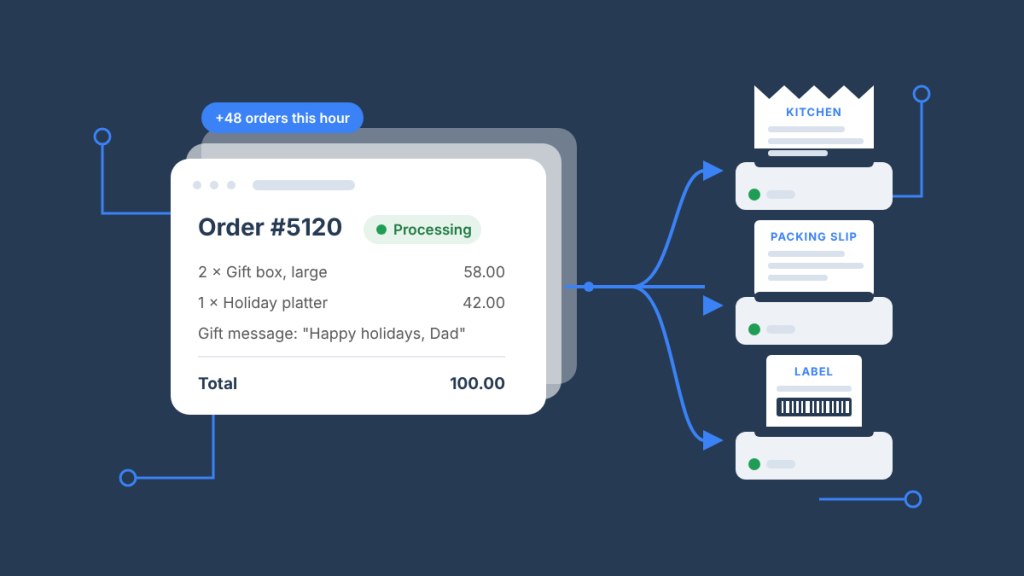
To prepare a WooCommerce store for high order volume, automate the physical steps, so that kitchen tickets, pick lists, packing slips and labels print themselves the moment an order is paid and nobody on the floor has to open the WordPress admin during the rush. WooCommerce high volume orders rarely break the website; they break the people standing between the Orders screen and the printer. This guide is a holiday checklist for the kitchen and the packing bench: what to print, when to print it, how to route it to the right station, what to do when a printer goes offline, and how to keep the fulfillment process moving when Black Friday or the December peak arrives.
Key Takeaways
- The bottleneck at peak is the admin screen, not the server. A store that needs a person to open each order, click Print and carry paper to the kitchen or bench caps out at whatever that person can do in an hour; status-triggered printing removes the person from the loop.
- Print on Processing, and add On hold if you take pay-at-pickup orders. WooCommerce sets Processing the moment payment clears, which makes it the right trigger for kitchen tickets, pick lists and packing slips; offline-payment orders sit On hold and need their own trigger.
- Route documents by product, category, shipping method or location. One order can print a kitchen ticket at the pass, a packing slip at the bench and a label at the shipping desk, with mapping deciding which items appear on which printer.
- Every station needs a backup before the rush. The most common cause of “printing stopped” is the station app not running; a second laptop, Raspberry Pi or Android device with the station app installed turns an outage into a two-minute swap.
- Run test orders on the real trigger, on the real printer, the week before. A test order placed through checkout proves the trigger, the template, the paper width and the printer in one pass; a dashboard “test print” proves only the last of those.
- Printing is one part of a fulfillment process. Accurate order details, visible shipping information, tracking, stock control and a packing slip in every parcel are what keep holiday orders from turning into January returns.
Why do WooCommerce stores struggle with high order volume?
WooCommerce stores struggle with high order volume because the Orders screen is designed for a person to work one order at a time, and at peak there are more orders than that person can open, print and hand off. WooCommerce has no printing of its own: per the WooCommerce order management documentation, the admin lets you view, filter, search and bulk-change the status of orders, but getting any of that onto paper means a browser print dialog or a plugin. During a normal week that gap is invisible. During a holiday surge, every printed ticket is a context switch for someone who should be cooking, picking or packing.
The symptoms are the same in a restaurant and a warehouse: orders that were paid twenty minutes ago and still have no ticket at the pass; a packer reading an order off a phone screen; duplicate prints because two people clicked Print; a kitchen cooking an order the customer cancelled; and, on the worst day of the year, a printer that stopped at 11am and nobody noticed until a customer called. Each of these is a process problem that a plugin solves in a settings screen, which is why fulfillment preparation for the holidays should start with the print layer rather than the theme or the ad budget.
What should a WooCommerce store print automatically during the holidays?
A WooCommerce store should print every document a person would otherwise print by hand, at the status where that document is first needed. With the BizPrint Print Manager for WooCommerce plugin, a template is paired with a printer in a location, and the order status change fires the job; the complete guide to WooCommerce automatic order printing walks through the six-step setup. The documents worth automating before a peak season are these.
| Document | Where it prints | Trigger status | Why it matters at volume |
|---|---|---|---|
| Kitchen ticket | Thermal printer at the pass, bar or prep station | Processing (and On hold for pay-at-pickup) | Cooking starts the second payment clears; no tablet to refresh |
| Pick list | Thermal or desktop printer at the stock room | Processing | A picker walks the shelves with paper, not a phone |
| Packing slip | Desktop or thermal printer at the packing bench | Processing, or a custom “Ready to pack” status | The slip is checked against the box and goes in the parcel |
| Shipping label | Label printer at the shipping desk | Completed, or when the label is generated | Labels print when the parcel is sealed, not in a batch at 6pm |
| Receipt or invoice | Counter printer, or the packing bench | Processing for receipts, Completed for invoices | Pickup customers get a receipt in the bag; B2B buyers get an invoice |
| Gift message or delivery note | Packing bench | Processing | Holiday orders are gifts; the note belongs with the item, not in an email |
Two documents are easy to forget. A gift message printed on the packing slip (or as its own slip) is the difference between a gift and a parcel, and December is when most gift orders arrive. And a delivery note for local-delivery orders gives the driver the address, the slot and the items without a phone in hand. Both come from the order fields WooCommerce already captures; the template decides whether they are printed.
What is the holiday readiness checklist for a WooCommerce kitchen or fulfillment setup?
The holiday readiness checklist is six steps, done in the order below, during the quiet week before the first promotion goes live. Each step takes minutes; skipping one is what produces the Saturday-afternoon outage.
- Audit every printer and station. Open the BizPrint Cloud dashboard and confirm each printer shows Online. On each station computer or device, confirm the BizPrint station app is running and shows a successful connection. Set every station computer not to sleep and not to require a login after a reboot. The documentation is explicit that the most common reason printing stops is that the station app is not actively running on the computer connected to the printer.
- Stock paper and consumables for the whole peak. Count the receipt rolls, label rolls and ink or toner you used last December and buy that plus a margin; a thermal printer with no paper is an outage nobody can fix at 9pm. Match the roll width to the layout size set in each location (80 mm is the usual thermal width; 58 mm printers need the layout to match or the right side of the ticket is cut off).
- Set up a backup station. Install the station app on a second device (a spare laptop, a Raspberry Pi, or an Android device for ESC/POS and StarPRNT receipt printers), connect it to BizPrint Cloud, and leave it on the shelf. Desktop stations run on Windows, macOS, Linux and Raspberry Pi OS; the hardware page lists the station options. If the main station fails, plug the printer into the backup and change the printer on the affected location.
- Review every trigger. Under WooCommerce → Print Manager → General, confirm Enable Automatic Printing is on and the trigger statuses are the ones your workflow actually uses. Processing for kitchens and packing; add On hold if you take cash on delivery or pay-at-pickup orders, which WooCommerce places On hold instead of Processing. Confirm automatic printing is enabled per printer on the Printers tab.
- Review every location’s mapping. Open each location and confirm its product or category mapping still matches your menu or catalog; new holiday products added to a category that is not mapped to the kitchen will silently never print. Check the shipping-method mapping if delivery and pickup tickets go to different printers.
- Place real test orders. Put a real order through checkout for each printer and each trigger: one card-paid order, one pay-at-pickup order, one that includes a product from every mapped category, one with a gift message. Check that each document printed once, at the right station, with nothing cut off. Then cancel or refund the test orders so they stay out of your reports.
The reason step 6 insists on a checkout-placed order is that a “test print” from the dashboard proves the station and printer are connected and nothing else. The trigger, the mapping, the template fields and the paper width are only proven by an order that moved through the status your real orders will move through.
How do you route WooCommerce orders to the right printer by status and location?
You route orders with two settings that work together: the trigger status decides when a document prints, and the location’s mapping decides which items print where. Both live in the Print Manager plugin, and a single order can satisfy several locations at once.
The trigger follows WooCommerce’s own status flow. Per the WooCommerce order statuses documentation, an order is Pending payment until the gateway responds, becomes Processing when payment is received, and is set to Completed when fulfilled; offline payments (bank transfer, cheque, cash on delivery) sit On hold. Processing is the first status that means “paid”, so it is the default trigger for almost everything. Completed is the right trigger for invoices and shipping labels, which are needed when the parcel is sealed. Custom statuses created by fulfillment or order-status plugins appear in the trigger list like any core status, so a store with a “Ready to pack” step can print the packing slip there instead of at Processing.
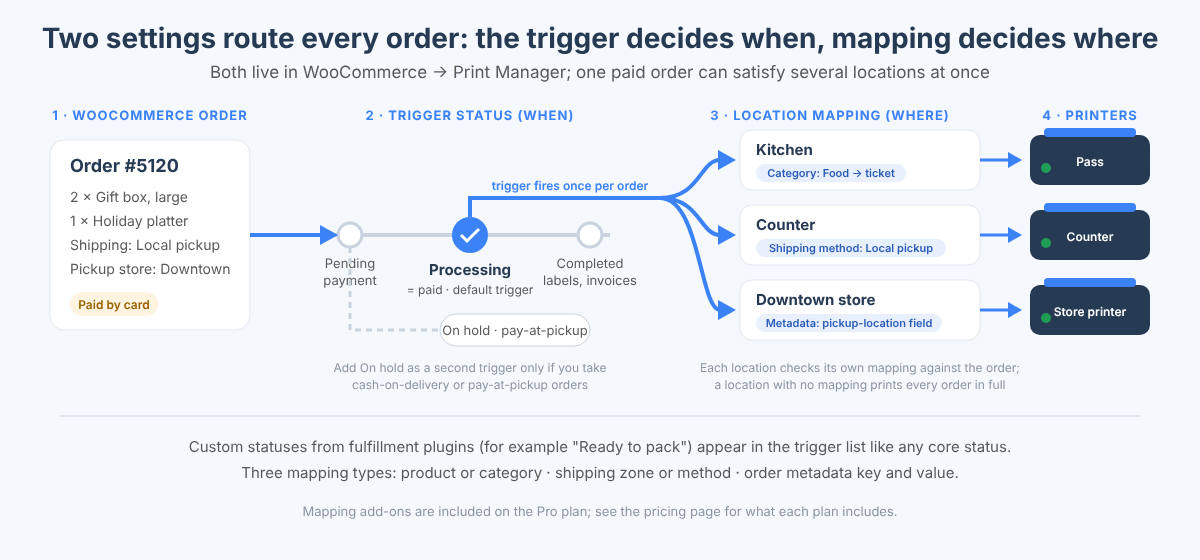
Mapping is per location, and the mapping add-ons give three ways to filter what each location prints: by product or category, by shipping zone or method, and by order metadata key and value. The table shows how the common holiday setups combine them.
| Operation | Locations | Mapping | What prints where |
|---|---|---|---|
| Restaurant: kitchen, bar, counter | 3 | Kitchen → Food category; Bar → Drinks category; Counter → no mapping | Food items at the pass, drinks at the bar, full receipt at the counter |
| Restaurant: pickup vs delivery | 2 | Shipping method: Local pickup → counter printer; Local delivery → dispatch printer | Pickup tickets at the counter, delivery tickets (with address) at dispatch |
| Retail store with a stock room | 2 | Stock room → pick list template, all products; Counter → receipt | A pick list in the stock room and a receipt at the counter for every pickup order |
| Two warehouses on one site | 2 | Shipping zone: East → warehouse A; West → warehouse B | Each packing slip prints only at the warehouse that ships it |
| Several physical stores, one WooCommerce site | 1 per store | Metadata: pickup-location field written by the store-locator plugin | Each store prints only the orders its customers chose to collect there |
Mapping is included on the Pro plan; the pricing page lists what each plan includes. The restaurant rows are the most common holiday setup on the site, and Restaurant Ordering with WooCommerce and Automatic Kitchen Tickets goes through a full kitchen configuration. Stores that run several locations on one WooCommerce install and have a plugin writing a pickup-location field to the order are the case for metadata mapping: the plugin reads that field and routes on it, with no custom code.
Ready to print WooCommerce orders automatically? Every BizPrint account starts with 25 free print jobs, no card required.
How do you handle pick lists and packing slips in batch at peak volume?
You handle pick lists and packing slips in batch by letting them print one at a time as orders arrive, and reserving WooCommerce’s bulk actions for the exceptions. That sounds backwards, so it is worth being precise about why.
A batch print at the end of each hour feels efficient, but it means every order waits up to an hour before anyone can start on it, and the person running the batch is the one bottleneck a surge will find. Status-triggered printing produces the same pile of slips with no waiting and no operator: each order’s slip is on the bench within seconds of payment, in the order the orders arrived, which is also the order the packers should work in. The batch happens continuously, on paper, without anybody clicking anything.
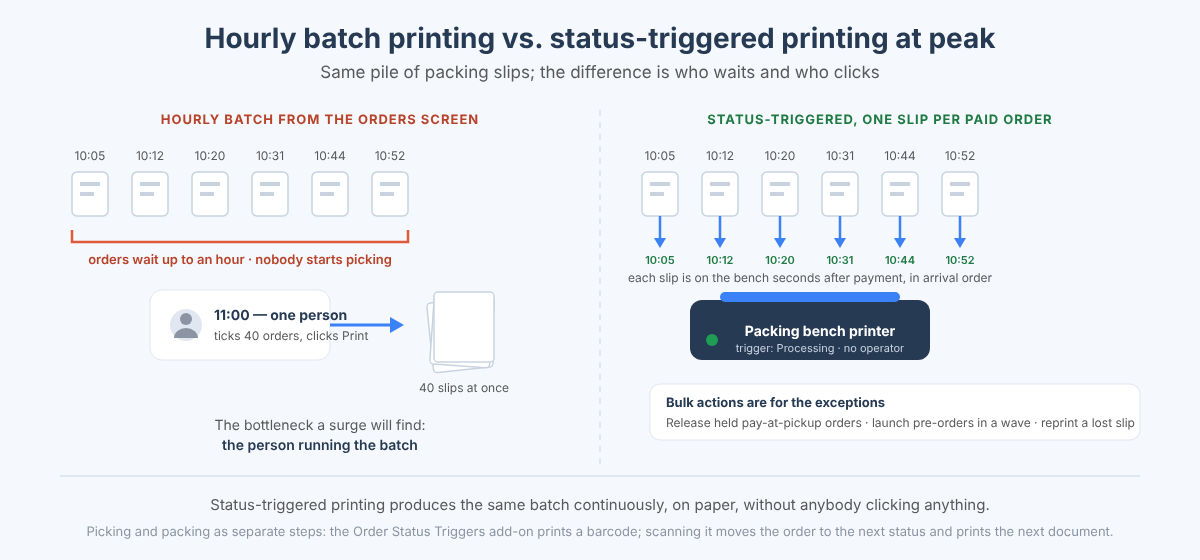
Bulk actions still have a place. The Orders overview and bulk management screen lets you tick orders and apply “Change status to Processing”, “Change status to On hold”, “Change status to Completed” or “Change status to Cancelled” in one action, and filter the list by status links, month and customer. Three holiday uses:
- Releasing held orders. If you cook or pack pay-at-pickup orders only after the customer is confirmed, filter the Orders list to On hold, tick the confirmed ones and change them to Processing; each one prints as it changes status.
- Pre-orders and backorders. Orders placed before stock arrives can be held in a custom status, then bulk-changed to Processing on the day the stock lands, which prints the packing slips in one wave without anyone opening the orders.
- Reprints. The Orders list has a Print column (enable it under Screen Options) for printing any single order again by hand, which is what you want when a slip is lost or torn rather than a second automatic copy.
For stores where picking and packing are separate steps, BizPrint’s Order Status Triggers add-on (included from Plus) prints a barcode on each document; scanning the barcode on the pick list moves the order to the next status, which prints the packing slip, and scanning the packing slip marks the order Completed. The orders screen never has to be opened to move an order from paid to shipped.
What happens when a printer goes offline during a rush?
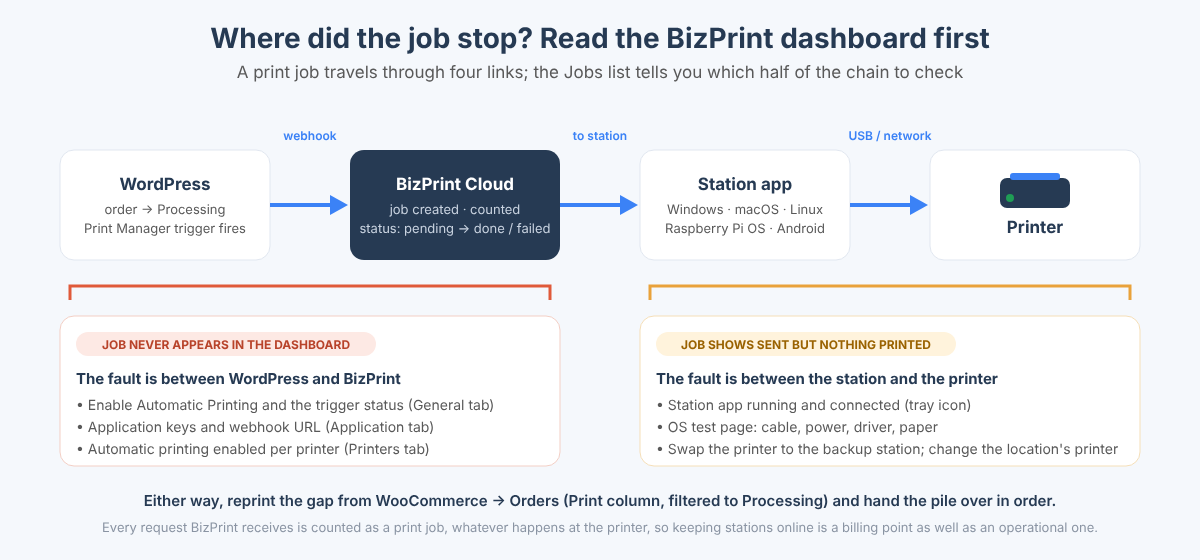
When a printer goes offline during a rush, orders keep arriving and BizPrint keeps receiving the jobs, so the fix is to get a station back online fast and then reprint anything that was missed from the Orders list. Two facts shape the plan. First, the printer’s status in the BizPrint Cloud dashboard shows Online or Offline, and each job carries a status (pending, processing, done, failed), so the dashboard is where you confirm whether jobs were created at all. Second, per the pricing page, every print request BizPrint receives counts as a print job, and what happens at the printer, such as a paper jam or an offline printer, does not change the count. Keeping stations online is therefore an operational point and a billing one: jobs that never reach paper were still sent.
The fastest recovery order:
- Check the station app. On the computer or device at the printer, look for the BizSwoop icon in the tray or notification area. If it is missing, launch the app; if it is present, open it, disconnect and reconnect until it reports a successful connection. A rebooted computer, a logged-out user or a sleeping laptop is the cause far more often than the printer.
- Check the printer in the operating system. Print a test page from Windows or macOS. If that fails, the problem is the cable, the power or the driver, and BizPrint cannot help until the OS can print.
- Swap to the backup station. If the station computer itself is dead, plug the printer into the backup device you prepared in the checklist, and change the printer on the affected location in Print Manager → Locations. Orders arriving from this point print on the backup.
- Reprint the gap. Filter the Orders list to Processing, sort by date, and use the Print column to reprint every order that arrived between the last printed ticket and the fix. Give the pile to the kitchen or bench in order.
- Note the time in the order notes of anything that was delayed, so the person handling customer questions later can see what happened.
If a job shows as sent in the dashboard but never printed, the fault is between the station and the printer; if the job never appears in the dashboard, the fault is between WordPress and BizPrint (the trigger, the application keys or the webhook). The troubleshooting table in the automatic printing guide covers both halves. Whether jobs created while a station was offline are delivered automatically once it reconnects is not something to plan around; treat the Orders list reprint as the recovery path and you will never be waiting on it.
How does printing fit into the rest of the WooCommerce order fulfillment process?
Printing is the document layer of a fulfillment process that runs from checkout to the customer’s door, and the rest of the process has to be ready for volume too. The practices below were part of this guide’s earlier edition and still hold; they are what keep a December surge from becoming a January returns queue.
- Make sure the order details reaching the kitchen or bench are complete. A ticket or slip that omits a variation, an add-on or a special instruction produces a wrong order. Check the template prints every field your products use; if an add-on or delivery-slot plugin writes fields the included template does not know, install its template extension from the marketplace or request one before the rush, not during it.
- Keep shipping details visible on paper. Print the shipping method and any delivery date on the packing slip, so a packer can see at a glance that an order is express and should jump the queue.
- Add tracking to orders and tell customers. WooCommerce order notes and a notification plugin (BizSwoop’s Flow Notify sends SMS, WhatsApp or email on status change) keep “where is my order” out of your inbox. A packing slip can also carry the tracking number if the label is generated before the slip prints.
- Control stock before the promotion starts. Overselling is the holiday failure that paper cannot fix. Set stock levels and low-stock thresholds, and if you sell in person as well as online, sync stock across both (a POS such as Jovvie does this for WooCommerce stores).
- Put a packing slip in every parcel. It is the customer’s record, the returns form and the packer’s checklist in one document; the slip template can include return instructions, the order number and the itemized list with images. If you also need PDF invoices or want to compare the slip plugins, Best WooCommerce Packing Slip and Invoice Plugins (2027) covers the options.
- Decide the returns and exchange policy now. Gift orders mean returns in January from people who are not the buyer; a clear policy printed on the slip removes most of the email.
Whether you fulfill in house, through a 3PL or a mix, the document layer is the same: in-house operations print at their own stations, a 3PL arrangement can print at the warehouse that ships the order (shipping-zone mapping), and a hybrid setup prints each order at whichever location handles it.
What else should a WooCommerce store check before a holiday peak?
Beyond the kitchen and the bench, a holiday peak tests the storefront, the payment flow and the people, and WooCommerce’s own nine-step holiday checklist covers the marketing side well. The items that most often interact with fulfillment are these.
- Last order dates. Publish the final order dates for each shipping method on the product, cart and checkout pages, and update them as carriers’ cutoffs change. Fulfillment capacity, not just carrier deadlines, should set the date.
- Staff and schedules. Hire or borrow help for picking and packing, and train everyone on the printed documents: what a kitchen ticket means, what a packing slip is checked against, and who reprints when something is lost.
- Seasonal products and bundles. Every new product or bundle must land in a category that is mapped to the right printer, or it will not print where you expect.
- Site performance and security. Keep WordPress, WooCommerce and plugins updated before the peak (not during it), make a full backup, and test checkout on a phone, because the holiday shopper is on one.
- Test everything on a real order. Checkout, payment methods, shipping rates, coupons and the printed output, in one pass, the week before.
When does automatic printing not solve the volume problem?
Automatic printing does not solve the volume problem when the constraint is physical rather than clerical: a kitchen that can plate forty orders an hour will not plate sixty because the tickets arrived faster. In that case the lever is throttling, not printing. WooCommerce stores can limit orders per time slot with a delivery or pickup scheduling plugin, pause a shipping method, or set a product to backorder, and the print layer simply follows whatever the store accepts.
It also does not help a store doing a handful of orders a day, where a PDF invoice plugin and the browser print dialog are fine, or a store whose fulfillment is entirely outsourced to a 3PL that prints its own documents. And stores that have outgrown the plugin’s templates, or that need printing from a kiosk, a POS or a custom ordering app, can create the same print jobs with the BizPrint Print API from their own code; the same stations and printers serve both.
Frequently asked questions
How do I prepare a WooCommerce store for high order volume?
Automate the physical steps first: install the BizPrint Print Manager for WooCommerce plugin, pair each document (kitchen ticket, pick list, packing slip, label) with a printer in a location, and trigger printing on the Processing status so every paid order prints itself. Then audit stations and paper, set up a backup station, review triggers and mapping, and place real test orders before the first promotion.
How many orders can WooCommerce handle?
WooCommerce itself handles very large order counts on adequate hosting; the practical limit at peak is usually operational, meaning how fast orders can be cooked, picked and packed. Removing the person who opens and prints each order from the loop is the single biggest change to that limit, followed by stock control and clear last-order dates.
How do I print WooCommerce orders automatically to a kitchen printer?
Install the Print Manager plugin, connect a station (a Windows, macOS, Linux, Raspberry Pi OS or Android device) to the kitchen’s thermal printer, add a location with the kitchen ticket template, map it to your food categories, and tick Processing as the trigger. Every paid order then prints at the pass within seconds; the automatic order printing guide has the step-by-step setup with screenshots.
Should WooCommerce print on Processing or Completed?
Print kitchen tickets, pick lists and packing slips on Processing, because it is the first status that means the order is paid. Print invoices and shipping labels on Completed, when the parcel is sealed. Add On hold as a trigger only if you take pay-at-pickup or cash-on-delivery orders, which WooCommerce holds instead of marking Processing.
What happens to WooCommerce print jobs if the printer is offline?
BizPrint still receives and counts the job, and the printer shows Offline in the dashboard. Get the station app running (or swap to the backup station), then reprint any missed orders from the Orders list using the Print column. Do not rely on jobs being delivered later; reprint the gap.
Can I print pick lists and packing slips in bulk in WooCommerce?
Yes, in two ways. Status-triggered printing prints each slip as its order is paid, which is a continuous batch with no operator. For a deliberate wave, such as releasing pre-orders, select the orders on the Orders screen and use “Change status to Processing” in Bulk actions; every order prints as its status changes.
Does BizPrint work for pickup and delivery orders during the holidays?
Yes. Pickup and delivery orders can print to different printers using shipping-method mapping (Local pickup to the counter, Local delivery to dispatch), and the ticket template can include the address and the delivery slot. BizPrint’s documentation confirms it works for pickup and delivery.
What should a WooCommerce holiday checklist include for fulfillment?
Printers and stations audited, paper and labels stocked for the whole peak, a backup station prepared, trigger statuses reviewed, location mapping checked against new seasonal products, and real test orders placed through checkout for each printer and trigger.
Get the kitchen and the bench ready before the rush
The holiday peak is won in the quiet week before it, and the highest-return hour you can spend is the one that takes a person out of the print loop. Install the plugin, pair your documents with your printers, set the triggers, prepare a backup station and run your test orders. Get 25 prints free, no card required, or see pricing for the plan that fits your holiday volume.
